How Industrial Robots Are Transforming Modern Manufacturing
Industrial robots are automated machines designed to perform repetitive, precise, and physically demanding tasks in manufacturing and industrial environments. They help businesses improve production consistency, manage complex operations, and support modern manufacturing processes.
An industrial robot typically consists of a mechanical structure, control system, sensors, motors, and specialized tools. These components work together to perform tasks such as welding, assembling, painting, packaging, and material handling.
Today, industrial robots are an important part of industrial automation. From automotive manufacturing to electronics production, robotic systems are helping factories develop more efficient and technology-driven production environments.
Why Industrial Robots Are Important in Modern Manufacturing
Manufacturing industries increasingly depend on automation to maintain production quality and operational consistency.
Industrial robots help address several common manufacturing challenges:
Production consistency: Robots can perform programmed movements repeatedly with consistent accuracy.
Operational efficiency: Automated systems can support continuous production workflows.
Workplace safety: Robots can handle certain hazardous, repetitive, or physically demanding tasks.
Product quality: Programmable movements help maintain consistent manufacturing processes.
Production flexibility: Modern robotic systems can be reprogrammed for different tasks and product configurations.
Industrial automation is also becoming more important as manufacturers introduce smart factories, connected equipment, and data-driven production systems.
Different Types of Industrial Robots
Understanding the available robot types helps manufacturers identify suitable automation technologies for their production requirements.
1. Articulated Industrial Robots
Articulated robots have multiple rotating joints that provide flexibility and a wide range of movement.
They are commonly used in automotive manufacturing, welding, painting, assembly, and material handling.
Six-axis industrial robots are particularly useful for complex operations that require movement in multiple directions.
2. SCARA Robots
SCARA stands for Selective Compliance Assembly Robot Arm.
These robots are designed for fast and precise operations, particularly in horizontal assembly applications.
Common applications include:
Electronics assembly
Component insertion
Packaging operations
Small-part handling
Precision manufacturing
3. Cartesian Robots
Cartesian robots operate along three linear axes: X, Y, and Z.
Their straightforward movement structure makes them suitable for applications that require controlled positioning.
They are commonly found in automated assembly, material movement, machine loading, and industrial inspection.
4. Delta Robots
Delta robots use a parallel-arm structure that supports fast movements and lightweight handling.
They are particularly useful in industries where speed and precision are important.
Typical applications include food packaging, pharmaceutical handling, sorting, and product picking.
5. Collaborative Robots
Collaborative robots, also known as cobots, are designed to work in environments where humans and automated equipment share tasks.
They can support assembly, inspection, packaging, and machine tending.
However, collaborative design does not automatically make every application safe for direct human interaction. A proper risk assessment and suitable safety measures remain necessary.
6. Mobile Industrial Robots
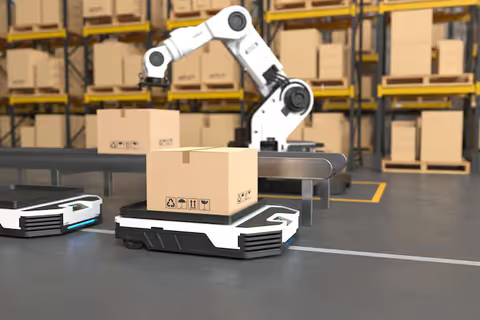
Mobile industrial robots move materials between different areas of a facility.
Many use sensors, cameras, mapping technologies, and navigation software to move through industrial environments.
They are commonly used in warehouses, distribution facilities, and manufacturing plants.
Industrial Robotic Arms and Their Applications
Industrial robotic arms are among the most widely recognized components of manufacturing automation.
An industrial robotic arm generally consists of connected mechanical segments, joints, motors, and an end effector. The end effector is the tool attached to the robot that interacts with materials or products.
Different end effectors include:
Mechanical grippers
Vacuum suction tools
Welding torches
Painting equipment
Cutting tools
Specialized assembly tools
Industrial robotic arms can support several production activities.
For example, a robotic welding system can follow programmed welding paths, while a pick-and-place robot can move components between production stations.
When evaluating robotic arm manufacturers, businesses should examine payload capacity, reach, repeatability, movement speed, controller compatibility, and available safety features.
Major Applications of Industrial Robots
Automotive Manufacturing
Automotive production facilities use industrial robots for welding, painting, component installation, material handling, and assembly.
Robotic automation supports repeatable production processes and helps manufacturers manage complex vehicle assembly operations.
Electronics Manufacturing
Electronics production requires careful handling and accurate component placement.
Robots can assist with circuit board assembly, component positioning, product inspection, and packaging.
Food and Beverage Processing
Industrial robots support product sorting, packaging, palletizing, and material movement.
Food-grade equipment and suitable hygiene procedures are important when selecting robotic systems for food production environments.
Pharmaceutical Manufacturing
Robotic systems can support packaging, laboratory handling, inspection, and controlled material movement.
The equipment must be suitable for the required cleanliness, documentation, and quality-control procedures.
Metal Fabrication
Metalworking facilities use robotic welding, cutting, grinding, polishing, and machine-tending systems.
These applications can help maintain consistent processes while reducing exposure to certain hazardous operations.
Warehousing and Logistics
Mobile robots and automated handling systems help move materials between storage areas, production lines, and distribution zones.
These systems are increasingly connected with warehouse management and inventory technologies.
Understanding Industrial Robotic Automation Systems
Industrial robotic automation involves more than installing a robotic arm. It combines several technologies that coordinate manufacturing activities.
Important components include:
1. Robot Controller
The controller processes instructions and coordinates robot movement, speed, positioning, and operating sequences.
2. Sensors and Machine Vision
Sensors provide information about position, distance, pressure, and surrounding conditions. Machine vision systems help robots identify objects and inspect products.
3. End Effectors
End effectors allow robots to perform specific tasks, including gripping, welding, painting, and cutting.
4. Programmable Logic Controllers
PLCs coordinate machinery, sensors, conveyors, and production equipment.
5. Human-Machine Interfaces
HMIs allow operators to monitor equipment status, adjust settings, and interact with automated processes.
6. Industrial Communication Networks
Connected industrial equipment uses communication technologies to exchange production information and coordinate operations.
Together, these components form an industrial robotic automation system that can support complex manufacturing workflows.
How to Select Industrial Robots for Manufacturing
Selecting the right industrial robot requires an understanding of production requirements, workplace conditions, and technical specifications.
Consider these important factors:
Payload capacity: Determine the maximum weight the robot needs to handle, including tooling.
Reach: Check whether the robot can access all required working positions.
Repeatability: Evaluate its ability to return to programmed positions consistently.
Operating speed: Consider the cycle time required for each manufacturing task.
Work environment: Review temperature, dust, moisture, and other environmental conditions.
Integration compatibility: Confirm that the robot can communicate with existing production equipment.
Safety requirements: Evaluate guarding, emergency stops, sensors, and risk-reduction measures.
Programming requirements: Consider the skills and software needed to configure and maintain the system.
Technical support: Review documentation, spare-part availability, maintenance requirements, and manufacturer support.
A suitable industrial robot should match the actual manufacturing application rather than simply having the highest payload or fastest operating speed.
Industrial Robot Manufacturers and Technology Providers
The industrial robotics market includes manufacturers that develop robotic arms, collaborative robots, mobile robots, controllers, and integrated automation technologies.
Well-known companies in this industry include:
FANUC
ABB Robotics
KUKA
Yaskawa Motoman
Kawasaki Robotics
Universal Robots
Mitsubishi Electric
Each company has different product ranges, technical specifications, and industrial applications.
When comparing industrial robot manufacturers, businesses should examine the equipment's application suitability, controller technology, software compatibility, safety documentation, and technical support network.
Recent Industrial Robotics Trends in 2026
Industrial robotics continues to evolve as manufacturers introduce connected and intelligent automation technologies.
Artificial Intelligence in Robotics
AI-based technologies are helping robotic systems interpret visual information, identify objects, and adapt to certain changing production conditions.
Machine Vision Integration
Advanced cameras and vision software help robots recognize products, inspect components, and perform more flexible handling operations.
Collaborative Automation
Cobots are expanding the range of manufacturing tasks that can be designed around human-machine cooperation, subject to application-specific safety assessments.
Smart Factory Integration
Industrial robots are increasingly connected with production monitoring platforms, industrial IoT systems, and manufacturing execution software.
Autonomous Material Handling
Mobile industrial robots are supporting material transportation and warehouse operations with improved navigation and coordination technologies.
These developments are contributing to wider interest in industrial automation and robotic manufacturing systems.
Industrial Robot Safety Standards and Regulations
Industrial robot installations must be designed around appropriate workplace safety requirements.
In the United States, the Occupational Safety and Health Administration (OSHA) provides workplace safety requirements and guidance relevant to industrial machinery and robotic operations.
Important safety considerations include:
Conducting application-specific risk assessments.
Installing appropriate machine guarding.
Providing emergency-stop systems.
Defining safe operating zones.
Training employees and maintenance personnel.
Establishing safe procedures for programming and servicing.
Reviewing robot and system integrator safety documentation.
International standards such as ISO 10218 and ISO/TS 15066 are also relevant to industrial robot and collaborative robot safety.
Manufacturers should review the applicable editions and requirements for their particular equipment and installation.
Tools and Resources for Industrial Robotics
Several technologies support the planning, programming, monitoring, and maintenance of industrial robotic systems.
Robot simulation software: Helps evaluate robot reach, movement, and production layouts before installation.
CAD software: Supports mechanical design and equipment layout planning.
PLC programming software: Helps coordinate robots with other industrial machinery.
Machine vision software: Supports product recognition, positioning, and inspection.
Industrial IoT platforms: Help monitor connected equipment and production information.
Predictive maintenance systems: Analyze equipment information to identify potential maintenance requirements.
Robot programming platforms: Help configure movement paths, operating sequences, and application-specific tasks.
Choosing appropriate tools depends on robot compatibility, production complexity, and the technical capabilities of the manufacturing team.
Frequently Asked Questions
1. What are industrial robots used for?
Industrial robots are used for welding, painting, assembly, packaging, material handling, inspection, machine tending, and other manufacturing activities.
2. What are the main types of industrial robots?
The main types include articulated robots, SCARA robots, Cartesian robots, delta robots, collaborative robots, and mobile industrial robots.
3. What is an industrial robotic arm?
An industrial robotic arm is a programmable mechanical system with connected joints and segments that performs tasks such as gripping, welding, assembling, and moving materials.
4. Which industries use industrial automation systems?
Automotive, electronics, aerospace, food processing, pharmaceuticals, metal fabrication, and logistics industries use industrial automation systems.
5. How do businesses choose industrial robot manufacturers?
Businesses should compare robot specifications, payload capacity, reach, repeatability, programming systems, application suitability, safety features, and technical support.
Conclusion
Industrial robots have become an important part of modern manufacturing and industrial automation. Different robot types support different production requirements, from precision electronics assembly to automotive welding and warehouse material handling.
Understanding industrial robotic arms, automation systems, manufacturers, safety requirements, and emerging technologies helps businesses make informed decisions about manufacturing operations.
As artificial intelligence, machine vision, collaborative robotics, and connected factory technologies continue to develop, industrial robots are expected to remain an important part of the manufacturing industry's technological progress.