Servo Motors: Types, Working Principles, Applications, Benefits, and Selection Guide
Servo motors are widely used in industrial automation, robotics, manufacturing equipment, and precision motion-control systems. They are designed to provide accurate control over position, speed, and torque, making them useful when conventional motors cannot provide the required level of precision.
As factories and businesses adopt automated production systems, servo motor technology has become an important part of modern industrial automation, machine control, robotics, and manufacturing operations.
What Is a Servo Motor?
A servo motor is an electric motor used in a closed-loop control system. Unlike a basic motor that may simply rotate continuously when power is supplied, a servo system continuously monitors the motor's movement and adjusts its operation to achieve the desired result.
A typical servo system includes:
- Servo motor
- Servo drive or amplifier
- Controller
- Feedback device
- Mechanical load
The feedback device, such as an encoder, provides information about the motor's actual position or speed. The controller compares this information with the desired movement and the servo drive adjusts the motor accordingly.
This feedback mechanism is one of the main reasons servo motors are suitable for precision automation and motion control.
How Does a Servo Motor Work?
The operation of a servo motor involves several components working together.
1. Controller Sends a Command
The control system determines the required movement. The command may specify a particular position, speed, or torque.
For example, an automated machine may instruct the servo system to rotate a shaft to a specific position.
2. Servo Drive Controls Power
The servo drive receives the command and regulates electrical power supplied to the motor.
Modern servo drives can continuously adjust motor operation according to changing load conditions and motion requirements.
3. Motor Produces Movement
The motor converts electrical energy into mechanical motion. Depending on the application, the motor may rotate continuously or move between specific positions.
4. Feedback Device Measures Movement
An encoder or another feedback sensor measures the motor's actual movement.
The feedback information is returned to the controller or servo drive.
5. System Corrects Errors
If the actual position differs from the commanded position, the control system can make corrections.
This creates a closed-loop system capable of achieving highly accurate motion.
Main Types of Servo Motors
Servo motors can be classified in several ways, including by their electrical design, operating characteristics, and application.
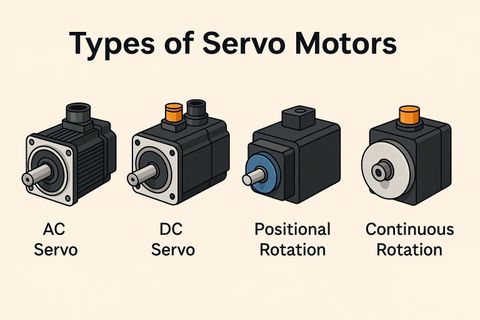
AC Servo Motors
AC servo motors are commonly used in industrial automation and manufacturing machinery.
They are valued for characteristics such as:
- High efficiency
- Reliable operation
- Precise speed control
- Good dynamic response
- Low maintenance requirements
AC servo systems are frequently found in CNC machines, packaging equipment, industrial robots, and automated production lines.
DC Servo Motors
DC servo motors have historically been used in various positioning and control applications.
They can provide good speed and position control, although modern industrial applications increasingly use AC and brushless servo technologies.
Brushless Servo Motors
Brushless servo motors eliminate mechanical brushes and commutators found in traditional brushed motor designs.
This can provide advantages including reduced mechanical wear, improved efficiency, and lower maintenance requirements.
Brushless technology is widely used in modern motion-control systems and industrial equipment.
Rotary Servo Motors
Rotary servo motors produce rotational movement and are among the most common types used in manufacturing.
They can drive:
- Machine tools
- Conveyors
- Robotic joints
- Packaging machinery
- Automated assembly equipment
Linear Servo Motors
Linear servo motors produce linear motion instead of conventional rotary motion.
They can be useful where machinery requires highly controlled linear positioning, particularly in advanced manufacturing and precision equipment.
Servo Motor Components
Understanding the major components of a servo system helps explain how the technology provides accurate motion.
Motor
The motor converts electrical energy into mechanical movement.
Encoder
An encoder provides feedback about position, speed, or direction.
High-resolution feedback can help a control system detect very small changes in motor movement.
Servo Drive
The servo drive controls the electrical power delivered to the motor.
It also processes feedback and helps regulate motor performance.
Controller
The controller determines what the motor should do. It may be part of a programmable automation system, CNC controller, robot controller, or specialized motion-control platform.
Mechanical Transmission
Depending on the machine design, a servo motor may connect to gears, belts, ball screws, couplings, or other mechanical components.
Servo Motor vs. Standard Electric Motor
Servo motors and conventional electric motors both convert electrical energy into mechanical energy, but their intended applications can be different.
| Feature | Servo Motor | Standard Motor |
|---|---|---|
| Position control | Excellent | Usually limited |
| Feedback | Commonly integrated | Often absent |
| Speed control | Highly precise | Application dependent |
| Torque control | Precise | Generally less sophisticated |
| Motion response | Fast | Depends on motor type |
| Typical applications | Automation, robotics, CNC | Pumps, fans, general machinery |
A standard motor can be an excellent choice for applications where continuous rotation is the primary requirement. A servo motor becomes more attractive when precision, positioning, dynamic response, or coordinated motion is important.
Applications of Servo Motors
Servo motors are used across many industries because automated equipment often requires controlled and repeatable movement.
CNC Machines
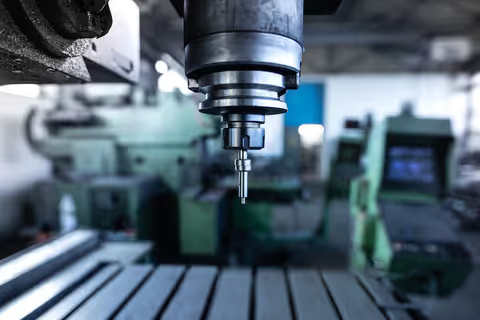
Computer numerical control machines use servo systems to control axes with high precision.
Servo motors can help control the movement of machine-tool components during cutting, drilling, milling, and other manufacturing processes.
Industrial Robotics
Robotic systems use servo motors to control individual joints and movement axes.
Precise motor control allows robots to perform repetitive tasks such as:
- Assembly
- Material handling
- Welding
- Pick-and-place operations
- Machine tending
Packaging Equipment
Packaging machinery often requires accurate synchronization between conveyors, feeders, cutters, and other mechanisms.
Servo motors can provide the controlled motion needed for high-speed packaging operations.
Printing Equipment
Printing systems can require precise synchronization between rollers, feeders, and other moving components.
Servo technology helps maintain controlled movement during high-speed operations.
Automated Manufacturing
Modern production lines may contain multiple servo motors operating together.
Motion controllers can coordinate these motors to perform complex sequences while maintaining consistent production performance.
Medical and Laboratory Equipment
Servo systems can also be used in equipment requiring controlled and repeatable movement, including certain laboratory automation and medical-device manufacturing applications.
Benefits of Servo Motors
High Positioning Accuracy
Servo systems use feedback to monitor movement, which can provide accurate positioning when properly designed and configured.
Fast Response
Servo motors can respond quickly to changes in commands and load conditions.
This makes them suitable for machines that frequently accelerate, decelerate, or change direction.
Precise Speed Control
A servo system can maintain controlled speed across changing operating conditions.
Controlled Torque
Servo drives can regulate motor torque, which can be useful in applications where mechanical force needs to be controlled.
Improved Automation Performance
Servo systems can support complex automated processes where several motion axes need to work together.
Reduced Production Variability
When properly engineered, automated motion control can improve repeatability and consistency in manufacturing processes.
Factors to Consider When Selecting a Servo Motor
Choosing the correct servo motor requires more than simply comparing motor power ratings.
Required Torque
Calculate the torque required to move the load under normal and peak operating conditions.
Starting torque, acceleration torque, friction, and mechanical transmission losses should all be considered.
Required Speed
Determine the required operating speed and maximum speed.
A motor should be selected based on the complete operating range rather than only its nominal speed.
Load Characteristics
The type and behavior of the load are important.
Engineers should consider:
- Load inertia
- Friction
- Acceleration
- Deceleration
- Duty cycle
- Mechanical transmission
Positioning Requirements
Applications requiring very accurate positioning may require a higher-resolution encoder and a suitable motion controller.
Operating Environment
Environmental conditions can affect motor selection.
Consider:
- Temperature
- Dust
- Moisture
- Vibration
- Available installation space
- Continuous operating conditions
Servo Drive Compatibility
The motor and servo drive must be compatible in terms of electrical ratings, feedback technology, communication protocols, and control requirements.
Total Cost of Ownership
The purchase price is only one part of the overall cost.
Businesses should also consider:
- Installation
- Commissioning
- Energy consumption
- Maintenance
- Replacement parts
- Downtime
- Service requirements
Servo Motors in Industrial Automation
Industrial automation is one of the largest application areas for servo technology.
Automated factories increasingly combine servo motors, programmable logic controllers, industrial robots, sensors, machine vision, and industrial networking to create coordinated production systems.
Servo motors can provide the controlled movement required by these systems.
For example, an automated assembly machine may use multiple servo axes. One motor could position a component, another could operate a feeder, and another could control a mechanical actuator.
Coordinating these movements allows manufacturers to automate complex production processes.
Servo Motors and CNC Technology
Servo motors are particularly important in CNC equipment because machining requires controlled movement along one or more axes.
A CNC system may use servo motors to control:
- X-axis movement
- Y-axis movement
- Z-axis movement
- Rotary axes
- Tool positioning
- Workpiece positioning
Accurate motion control can influence machining accuracy, surface quality, cycle time, and production consistency.
Servo Motor Maintenance
Servo motors generally require less mechanical maintenance than many traditional motor technologies, particularly brushless designs. However, the complete servo system still requires appropriate maintenance.
Inspect Connections
Electrical and feedback connections should be checked according to the equipment manufacturer's maintenance procedures.
Monitor Temperature
Unexpected increases in motor or drive temperature can indicate overload, ventilation problems, bearing issues, or other system conditions.
Check Mechanical Components
Couplings, belts, gears, bearings, and other mechanical components can affect servo performance.
Monitor Alarms
Modern servo drives often provide diagnostic information and alarm codes. Reviewing these warnings can help identify problems before they result in equipment downtime.
Follow Manufacturer Specifications
Maintenance intervals and procedures should always follow the motor, drive, and machine manufacturer's recommendations.
Common Servo Motor Problems
Even well-designed servo systems can experience problems.
Positioning Errors
Positioning errors may result from incorrect tuning, mechanical backlash, excessive load, encoder problems, or control-system issues.
Excessive Vibration
Vibration can be associated with mechanical imbalance, resonance, improper tuning, worn components, or installation problems.
Motor Overheating
Overheating can occur because of excessive load, insufficient cooling, incorrect operating conditions, or electrical problems.
Unexpected Alarms
Servo drives can generate alarms when they detect conditions such as overload, overcurrent, feedback errors, or excessive following error.
Proper troubleshooting should begin with the equipment documentation and diagnostic information.
Servo Motor Efficiency and Energy Management
Energy efficiency is an increasingly important consideration in industrial equipment.
Servo systems can regulate motor operation according to the machine's actual motion requirements. During periods of lower demand, the system may avoid operating continuously at unnecessary output levels.
However, actual energy savings depend on the motor, drive, machine design, duty cycle, load, and control strategy.
Businesses evaluating industrial energy management should therefore assess the complete system rather than assuming that replacing a motor automatically produces a specific level of savings.
Servo Motors and Smart Manufacturing
The development of smart manufacturing is increasing the importance of connected motion-control equipment.
Modern servo drives may communicate with industrial networks and provide operational information to automation systems.
This can support:
- Machine monitoring
- Predictive maintenance programs
- Production analytics
- Equipment diagnostics
- Motion synchronization
- Performance optimization
When integrated with industrial software and data systems, servo technology can become part of a broader Industry 4.0 and digital manufacturing strategy.
Servo Motors in Robotics and Automation
Robotics requires precise control over multiple axes.
A robot may have several servo motors, with each motor controlling a particular joint or movement axis. The robot controller coordinates these motors to produce the required motion.
The combination of servo motors, encoders, drives, controllers, and software allows industrial robots to perform repeatable movements at high speed.
This makes servo technology an important component of robotics automation and advanced manufacturing systems.
Servo Motor Cost Considerations
The cost of a servo system varies significantly depending on its specifications and application.
Factors that influence total cost include:
- Motor power
- Torque requirements
- Encoder resolution
- Servo drive
- Controller
- Communication interface
- Mechanical components
- Installation requirements
- Commissioning
- Maintenance requirements
A lower purchase price does not necessarily represent the lowest overall cost. Businesses should evaluate total cost of ownership, expected operating life, energy requirements, maintenance, and productivity when comparing motion-control solutions.
Frequently Asked Questions
What is the main purpose of a servo motor?
The main purpose of a servo motor is to provide controlled and precise motion, particularly for applications requiring accurate position, speed, or torque control.
Are servo motors used in robotics?
Yes. Servo motors are widely used in industrial robotics to control robot joints and movement axes.
What is the difference between a servo motor and a regular motor?
A servo system normally uses feedback and a control system to precisely regulate movement. A conventional motor may be designed primarily for continuous rotation without integrated closed-loop positioning.
Are servo motors suitable for CNC machines?
Yes. Servo motors are commonly used in CNC systems where accurate and coordinated axis movement is required.
Do servo motors require maintenance?
Servo motors can have relatively low maintenance requirements, especially brushless designs, but the complete servo system should still be inspected and maintained according to manufacturer recommendations.
How do I choose a servo motor?
Selection should consider torque, speed, load inertia, acceleration, positioning accuracy, duty cycle, environmental conditions, feedback requirements, drive compatibility, and total cost of ownership.
Conclusion
Servo motors are an important technology in modern industrial automation, robotics, CNC machining, packaging, manufacturing, and precision motion-control systems. Their ability to combine motor power with feedback and intelligent control makes them suitable for applications where accurate and repeatable movement is required.
As manufacturers continue investing in automation, digital manufacturing, and smart production systems, servo technology is likely to remain an important part of modern machine design.
For businesses evaluating servo systems, the best solution depends on the specific application. Motor size, torque, speed, feedback, controller compatibility, operating environment, maintenance requirements, and total cost of ownership should all be evaluated before selecting equipment.