Tissue Paper Manufacturer China: Industry Guide
China has developed a large and technologically advanced tissue paper manufacturing industry serving both domestic and international markets. Tissue products include toilet tissue, facial tissue, kitchen towels, napkins, and other household and hygiene paper products. Recent industry reports show continued investment in modern production equipment and manufacturing technology.
The phrase tissue paper manufacturer China generally refers to companies and production facilities involved in producing tissue parent rolls or converting them into finished tissue products. Understanding the manufacturing process, raw materials, equipment, quality standards, and environmental considerations can help readers better understand this industrial sector.
Tissue Paper Manufacturing in China
China's tissue paper industry has expanded through investments in modern paper machines, automated production systems, and improved converting technology. In 2024, approximately 70 tissue machines were put into operation across 30 companies, adding around 1.648 million tonnes per year of modern production capacity.
The industry also has an important export component. Tissue paper exports from China increased substantially during 2024, demonstrating the role of Chinese production facilities in international tissue paper supply chains.
Raw Materials Used in Tissue Paper
Virgin Wood Pulp
Virgin wood pulp is an important raw material for tissue manufacturing, particularly where softness, strength, absorbency, and cleanliness are important. Different pulp grades can influence the texture and performance of the finished tissue.
Recycled Fiber
Recycled fiber can also be incorporated into certain tissue products. Its suitability depends on the required product characteristics and applicable quality requirements. Research on China's pulp and paper sector highlights the importance of coordinated fiber supply and waste-paper management for long-term sustainability.
Water and Process Chemicals
Water is used throughout paper production, while carefully controlled process chemicals can support characteristics such as brightness, strength, softness, and machine performance. Manufacturing facilities generally manage water, energy, and chemical use as part of production efficiency and environmental management.
Tissue Paper Manufacturing Process
Pulp Preparation
The process generally begins with preparing the required pulp mixture. Fiber is dispersed in water and processed to achieve the characteristics required for the intended tissue grade.
Tissue Paper Formation
The prepared fiber suspension is distributed onto a forming system, where water is removed and a continuous paper web develops. Modern tissue machines use specialized forming, pressing, drying, and creping technologies to produce lightweight tissue paper.
Drying and Creping
Drying removes remaining moisture from the paper web. Creping is an important tissue manufacturing step because it contributes to softness, stretch, bulk, and absorbency.
Jumbo Roll Production
After the tissue web reaches the required condition, it is wound into large parent or jumbo rolls. These rolls can then move to converting operations for production into specific consumer or commercial formats.
Converting and Packaging
Converting equipment can transform jumbo rolls into toilet rolls, facial tissues, folded tissues, kitchen towels, napkins, and other formats. Equipment may include rewinders, cutters, folders, embossing systems, and packaging machinery.
Types of Tissue Paper Products
Toilet Tissue
Toilet tissue is one of the major tissue categories and is designed primarily for personal hygiene applications. Product characteristics can include softness, absorbency, strength, sheet size, and ply configuration.
Facial Tissue
Facial tissue is generally manufactured with an emphasis on softness and a comfortable surface. It is commonly produced in boxed or folded formats.
Kitchen Tissue
Kitchen tissue is designed for household cleaning and liquid absorption. Strength and absorbency are important characteristics for this category.
Paper Napkins
Paper napkins are used in households, hospitality environments, food-service applications, and other everyday settings. They may be produced in different sizes, folding patterns, and paper grades.
Tissue Paper Manufacturing Technology
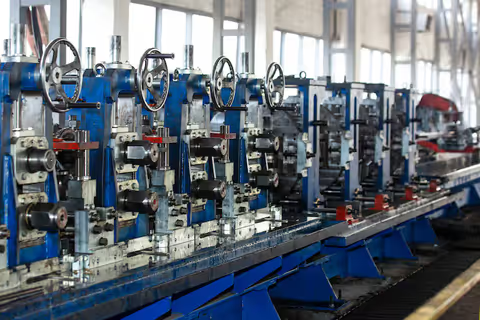
Modern Chinese tissue manufacturers increasingly use high-speed tissue machines, automated controls, advanced converting equipment, and integrated production systems. Industry reports indicate that Chinese equipment manufacturers have also expanded their presence in international markets.
Automation can help manufacturers maintain consistent production conditions, monitor equipment performance, reduce manual intervention, and improve manufacturing efficiency.
Quality Factors in Tissue Paper
Softness and Strength
Softness and strength need to be balanced according to the intended application. Increasing one characteristic can sometimes affect other properties, so manufacturers control fiber selection, refining, basis weight, creping, and converting conditions.
Absorbency
Absorbency is particularly important for kitchen towels and other products designed to handle moisture. Fiber characteristics, sheet structure, and manufacturing conditions influence how quickly tissue absorbs liquid.
Basis Weight and Ply
Basis weight describes the mass of paper per unit area, while ply refers to the number of tissue layers combined in a product. These factors influence thickness, strength, softness, and overall product characteristics.
Sustainability in Tissue Manufacturing
Environmental performance has become an important consideration in the pulp and paper industry. Research into China's paper sector has emphasized improved material efficiency, recovered paper management, recycling, and responsible fiber supply as components of a more sustainable production system.
Modern manufacturing facilities can also focus on energy efficiency, water management, waste reduction, equipment optimization, and improved production controls. Sustainability performance, however, varies between individual facilities and products.
China Tissue Paper Industry Trends
Modern Production Capacity
The Chinese tissue sector continues to invest in modern production capacity and manufacturing technology. During 2025, the industry added approximately 1.488 million tonnes per year of modern production capacity, according to a 2026 industry report.
Product Development
Manufacturers are increasingly developing differentiated tissue products with different levels of softness, strength, absorbency, sheet configuration, and intended use. Technology improvements have supported greater product segmentation and quality control.
International Trade
China has become an important exporter of tissue paper and related products. Industry data reported strong growth in tissue exports during 2024, while Chinese tissue-machine manufacturers also expanded equipment exports to international markets.
What to Understand About a Tissue Paper Manufacturer in China
When researching the tissue paper manufacturing industry, important factors include production technology, raw material sources, product categories, manufacturing capacity, quality management, environmental practices, and converting capabilities.
A manufacturer focused on parent rolls may have a different production structure from a company focused primarily on finished consumer tissue. Therefore, understanding the manufacturing stage is important when comparing different companies or studying the tissue paper supply chain.
Conclusion
China's tissue paper manufacturing industry combines large-scale production, modern paper-making equipment, automated converting systems, and an extensive domestic and international supply chain. Continued investment in production technology, product quality, resource efficiency, and environmental management is shaping the development of the sector.
For readers researching tissue paper manufacturer China, understanding raw materials, manufacturing processes, tissue categories, quality factors, technology, and sustainability provides a useful foundation for evaluating how the industry operates.